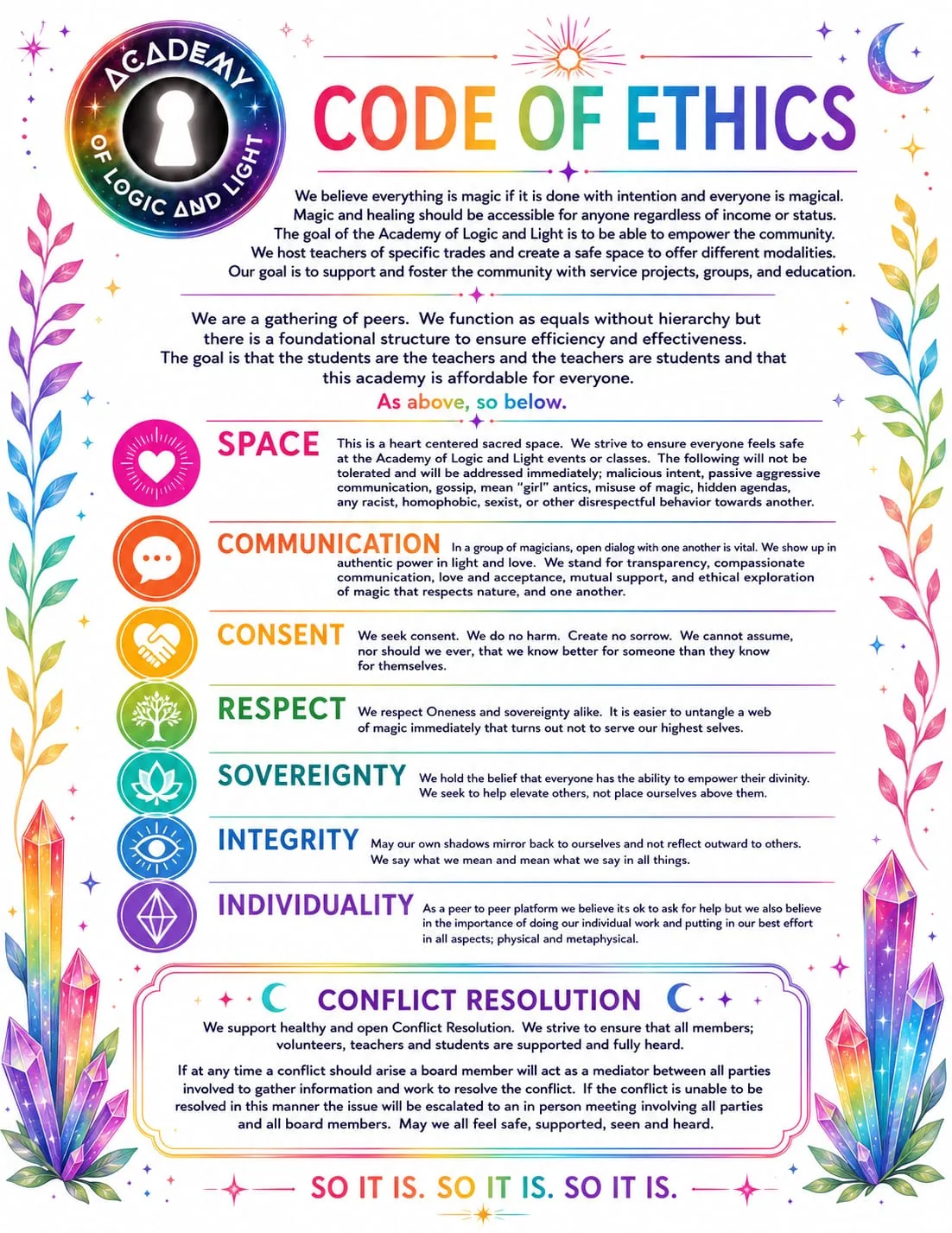
We support healthy and open conflict resolution. If a conflict arises, reach out and a board member will act as a mediator between all parties involved.
hello@academyoflogicandlight.comWhat we bring into a hard conversation
Borrowed, with gratitude, from don Miguel Ruiz. Four lines that hold up remarkably well the moment a conflict is live and everyone in the room is doing their best with what they have.
- 01
Be impeccable with your word
Say the true thing, say it kindly, and say it to the person it concerns. Gossip is the fastest way to turn a misunderstanding into a wound, and clean speech is the fastest way back.
- 02
Take nothing personally
What someone brings into a conflict usually started long before you walked in. Hear it fully, hold it lightly, and stay curious about the story running underneath it.
- 03
Make no assumptions
Ask the question. Ask it again if the answer surprises you. Almost every conflict here has turned out to be two people describing the same moment in two different languages.
- 04
Always do your best
Your best on a rested Tuesday and your best in a hard week look different, and both count. Come as you are, name your capacity out loud, and we will meet you there.
From The Four Agreements by don Miguel Ruiz, 1997.
How this works, in practice
Something felt off. Is it big enough to bring up?
Yes. Small things are the easiest ones to resolve, and the Academy would rather hear about a moment that sat wrong with you today than a pattern that hardened over six months. Bringing something forward is a contribution to the container, and it is treated that way.
What happens after I reach out?
A board member reads it, replies to you first, and asks what a good outcome would look like in your own words. From there they act as a mediator between everyone involved, at a pace that works for the people in it. You stay in charge of what you share and how far it goes.
Will the other person know it came from me?
Mediation works best when both people know who is in the room, so in most cases yes, and always with your say-so first. If you want something raised anonymously as a pattern rather than an incident, tell us that when you write, and we will honor it.
What if the conflict involves a teacher, a board member, or Julie?
The same process applies, and anyone named in a conflict steps out of mediating it. Sovereignty over authority is the whole model: rank inside the Academy changes none of your standing in this process.
I would rather work it out directly. Is that fine?
That is the preferred outcome. The four agreements above are the toolkit for exactly that conversation. Mediation is here for the moments when a direct conversation stalls, feels unsafe, or has already been tried.
What if we still disagree at the end?
Some conflicts close with an agreement, and some close with two people who understand each other and still choose differently. Both are real resolutions. What the Academy holds is that everyone leaves the conversation with their dignity and their autonomy intact.
Hear why the Academy wrote this code before almost anything else: Episode 2 of The A.L.L. Podcast is all ethics.
Listen to the Ethics episode ▸The code is how we treat each other. The 12 laws of the universe are the older pattern beneath it: how energy moves, and how to move with it.
Explore the 12 laws ▸The Academy aims to structure events in ways that are inclusive and safe for anyone at any part of their journey. We believe the more informed you are, the safer you can feel. We will keep learning and growing together, with grace and patience, and we will continue to weave trauma-informed care into our community. The Container Field Guide is how this code becomes architecture: every gathering marked, held, and closed on purpose.
Read the Container Field Guide ▸